
Share:


In Utah’s Box Elder County, TV personality Kevin O’Leary’s $100 billion, 40,000-acre Stratos Data Center Project has faced fierce opposition. On Instagram, environmental activist and pro skier Caroline Gleich, who ran for the U.S. Senate in 2024, captured the public sentiment: “What is Utah getting in exchange for a 9-gigawatt gas plant, 1 billion gallons of water per year, and 40,000 acres?”
In Archbald, Pennsylvania (population 7,000), where data center development could reach the equivalent of erecting 51 Walmarts, residents pushed for local officials to step down. They succeeded: Most of the Archbald Borough Council and planning board has resigned, and two council members expressed fear that what happened to an Indiana politician could happen to them. Earlier this spring, Indianapolis city council member Rob Gibson, who supported a data center in his district, woke up to the sound of gunshots being fired into his home. On his doorstep, he found a note: “No data centers.”
America’s fastest-growing industry is also its most contentious.
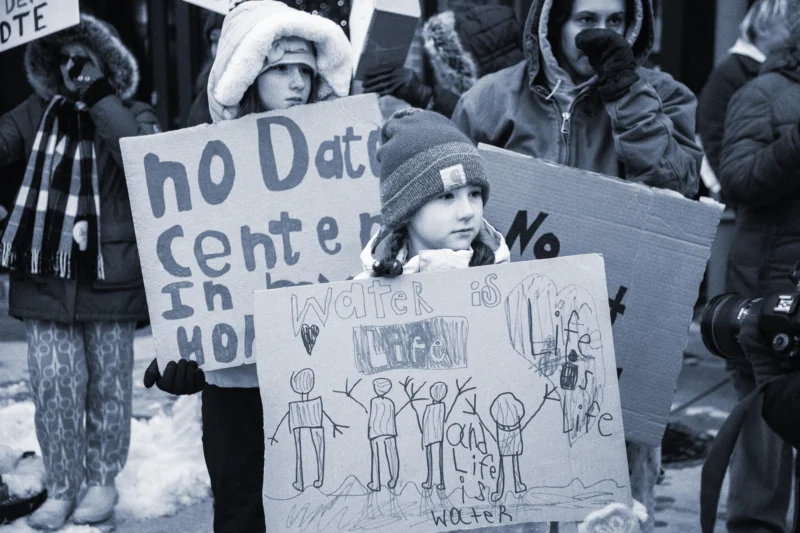
AI-fueled data center development is now America’s fastest-growing source of industrial investment, with up to $7 trillion going to scale data centers globally by 2030. But as investments have grown, so has community opposition: According to a first-of-its-kind Gallup Poll, 70% of Americans oppose the construction of data centers for AI in their area. There’s now a national coalition to stop big data centers. The New York Times has called the opposition to data center development the most bipartisan issue since beer.
Just a few months ago, the biggest blocker to building data centers was access to power. Now it’s community opposition. In 2025, almost 50 data center projects were blocked or delayed, affecting $156 billion in potential investments.
Because developers treat communities as a resource from which to extract—instead of a partner worth investing in—every new project is a fight. Meanwhile, community concerns are mounting. Some are worried about environmental impacts. Others have economic concerns. Some simply don’t like AI. Frustrated about the secrecy of data center projects, and shut out of decisions being made in their own backyards, people and communities are demanding a voice.
It’s time for data center developers to give it to them. By listening to communities, prioritizing their needs, and delivering social and economic benefits that secure a better future, data center developers can gain the license to build and operate. The case for community engagement is clear: Opposition causes friction and costs time, money, and heartache. Things would be smoother if communities were engaged and felt the development would benefit them.
Key tenets of community engagement to deploy now.
The issues facing data center developers aren’t new. Every company, from oil and gas to mining, nuclear power to wind energy, has needed to gain the social license to operate in local communities.
I’ve spent nearly 15 years working with these industries to engage with host communities from infrastructure design and planning through construction and operation. This work has included helping companies understand, manage, and mitigate their actual and potential impacts. It has involved building tools for companies to work collaboratively with communities to identify investments that would have the greatest positive impact. I have even helped companies repair relationships and restore trust with communities when promises were broken.
This work has taught me that it is possible to have a positive and mutually beneficial relationship with communities. These are key ways to demonstrate commitment and build trust:
Respect the community’s unique environment and cultural identity.
Many data centers are being established in agricultural and rural communities, where livelihoods and lifestyles are dramatically different from most developers’ experiences. Companies can bridge the cultural gulf by working to understand community values, economic drivers, and way of life.
Design data centers with communities, not around them.
Engage early—co-creation can lead to innovation that’s beneficial for both companies and people. Assess potential impacts on the community, local environment, and economy, and proactively share mitigation plans. Invite communities into the planning process, and allow community concerns, needs, and desires to shape design.
Build in transparency and accountability from the start.
Provide ways for community members to share questions and grievances, and create clear processes to address and respond to their concerns. This instills trust, lessens tensions in the face of challenges, and helps address small issues before they escalate into major opposition.
Deliver results for the community.
Engagement strategies should deliver meaningful outcomes for communities in the context of their unique cultural identities and needs. Investments could support energy and water infrastructure, economic diversification, workforce development, schools, and affordable housing.
Right now, there’s a vacuum of leadership when it comes to integrating community needs into data center development. That means that the first company to do this well will win: These projects won’t just face fewer obstacles; they’ll move faster, cost less, and deliver stronger, more enduring success for everyone.
Data center development is a huge opportunity for investment in America. Done well, it can power thriving communities and create sustainable, long-term value. But this future depends on community support, and to earn that support, developers must address the critical question: What’s in it for the community?